
What is a painting contractor? LA property guide

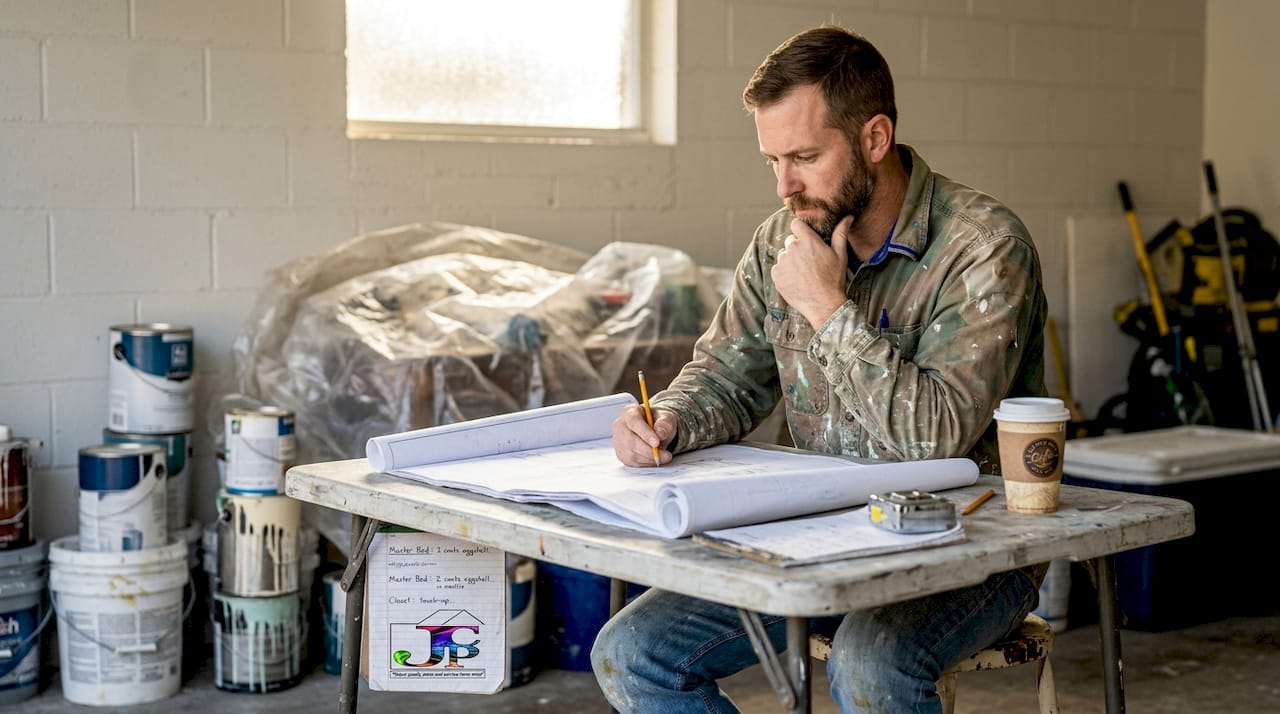
Most property owners in Los Angeles assume a “painter” and a “painting contractor” are the same thing. They are not, and the difference can cost you thousands. A licensed painting contractor carries legal responsibilities, insurance, and technical credentials that a handyman or independent painter simply does not. This guide breaks down exactly what a painting contractor is, why California licensing matters, what services you should expect, how eco-friendly paint choices affect your property, and what realistic pricing looks like in 2026. By the end, you will know how to hire smart and avoid the most common mistakes LA property owners make.
Table of Contents
Key Takeaways
Point | Details |
Licensed professionals matter | Only C-33 licensed and certified contractors can legally handle larger or regulated painting jobs in Los Angeles. |
Surface prep is crucial | Up to 90 percent of paint job quality depends on meticulous surface preparation. |
LA requires compliance | EPA RRP, C-33 licensing, and climate-specific paints are mandatory for both safety and longevity. |
Eco paints are on the rise | Low and zero-VOC paints reduce environmental and health risk without sacrificing performance. |
Know the price factors | Understand square-foot pricing, what’s included, and when to hire a pro versus doing it yourself. |
What is a painting contractor?
Now that we have addressed the common confusion, let’s break down what truly defines a painting contractor. The term gets used loosely, but there is a precise meaning behind it. A painting contractor is a licensed trade professional or firm that specializes in surface preparation and application of coatings for decorating, protecting, and waterproofing structures. That definition includes legal accountability, not just a brush and a bucket.
The gap between a licensed contractor, a handyman, and a DIY approach is significant. Here is a quick comparison:
Factor | Painting contractor | Handyman | DIY |
License required | Yes (C-33 in CA) | No | No |
Insurance | Yes | Sometimes | No |
Permit handling | Yes | Rarely | No |
Warranty offered | Yes | Rarely | No |
Lead paint compliance | Required | Often skipped | Often skipped |
Project scope | Any size | Small jobs | Small jobs |
A licensed contractor can plan a full project, handle permits, manage safety compliance, and back their work with a warranty. That is a fundamentally different service than someone who shows up with a roller. Licensed painters in LA are also required to meet California’s strict bonding and insurance standards before they can legally bid on a job.
One industry truth worth knowing: surface preparation accounts for roughly 70% of the total work on any professional paint job. A contractor who skips or rushes prep is cutting corners on the most important phase. To obtain the C-33 license in California, applicants must prove four years of journeyman experience, pass trade and law exams, and carry active insurance. That vetting process protects you as a property owner.
“A painting contractor is not just someone who applies paint. They are a licensed professional responsible for the full scope of surface preparation, application, safety, and project management.”
Key services painting contractors provide
Understanding who a painting contractor is makes it easy to see why the services they deliver set them apart. The process starts well before a brush touches a wall.
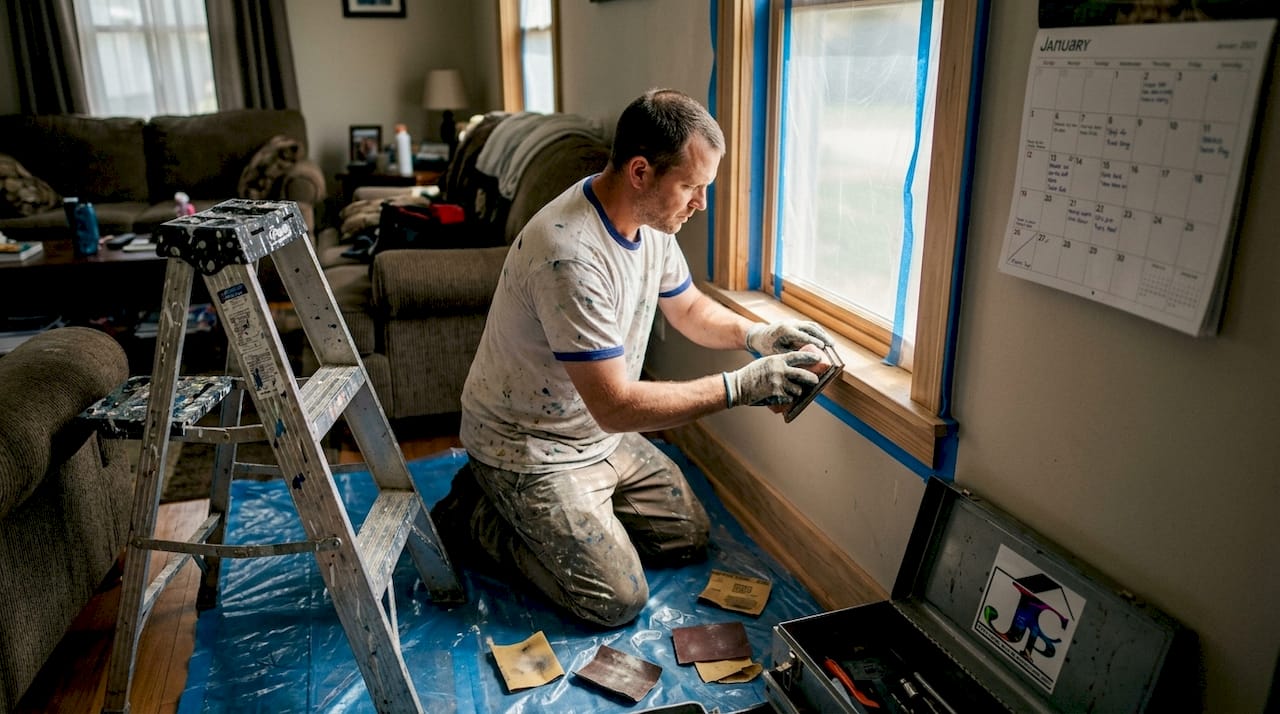
A professional contractor begins with a site assessment and consultation. They evaluate surface conditions, identify moisture issues, check for lead paint in older buildings, and develop a project plan. This phase alone separates professionals from amateurs.
Here is what a full-service engagement typically includes:
Surface preparation: Scraping, patching, sanding, caulking, and priming. Surface preparation techniques are the foundation of any lasting result.
Paint application: Brush and roller for detail work; airless sprayers for large surfaces at 300 to 400 sq ft per hour.
Quality inspection: Work is checked against PDCA P1 standards before project closeout.
Specialty services: Wallpaper removal, decorative textures, historic restoration, and eco-friendly coating systems.
Cleanup and compliance: Hazardous waste disposal, especially on older properties.
The core methodologies follow PDCA P1 standards, covering site assessment, surface prep, priming, application, inspection, and cleanup with hazardous waste compliance. That structured process is what separates a professional result from a paint job that starts peeling in 18 months.
Pro Tip: Ask any contractor what their prep process looks like before you discuss paint brands or colors. If they cannot describe a detailed prep sequence, walk away. Prep determines paint durability for LA homes more than any other single factor.
For application methods on commercial jobs, the standards are even more demanding, often requiring specific spray equipment, containment systems, and multi-coat schedules.
Licensing, compliance, and what matters in Los Angeles
Beyond skills and tools, legal compliance defines a true painting contractor, especially in LA. California is one of the most regulated states for construction trades, and painting is no exception.
Painting contractors must hold a C-33 license from the Contractors State License Board for any job exceeding $500 in combined labor and materials. That requires four years of verifiable journeyman experience, passing trade and law exams, bonding, and active insurance.
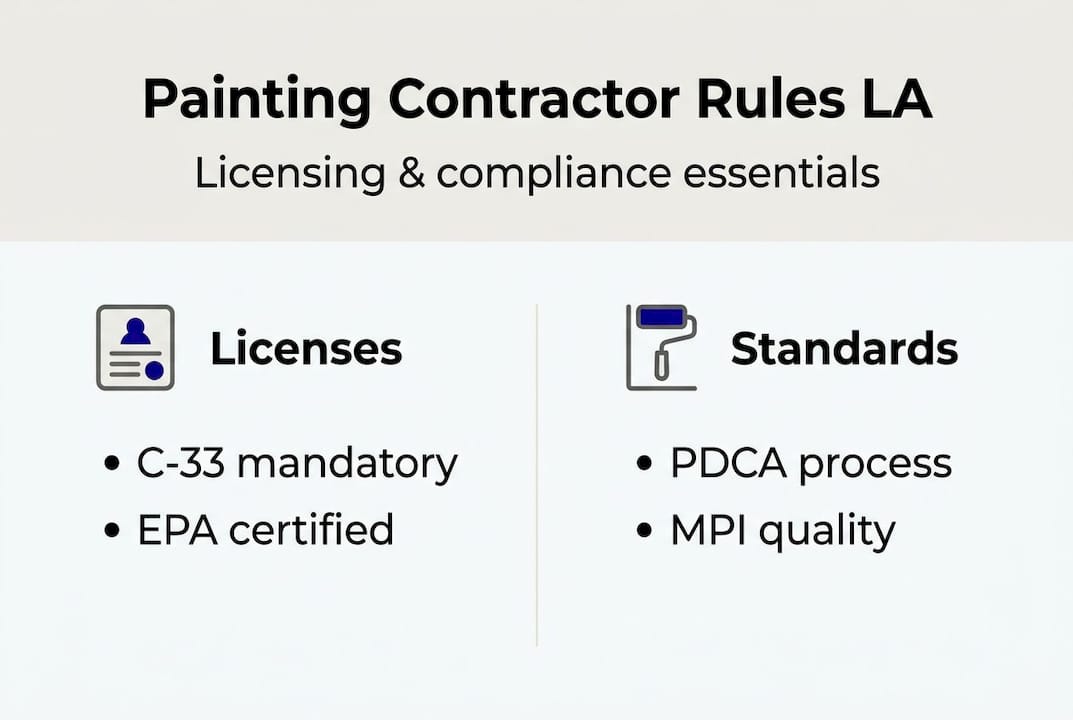
Here is a summary of compliance requirements by job type:
Job size | License needed | Lead compliance | Potential fine |
Under $500 | No | Recommended | Varies |
$500 to $5,000 | C-33 required | Required if pre-1978 | Up to $15,000 |
Over $5,000 | C-33 required | Required if pre-1978 | Up to $37,500 |
Commercial | C-33 required | Full EPA RRP | Up to $37,500/violation |
Steps every legitimate LA painting contractor must follow:
Register with the CSLB and maintain an active C-33 license.
Carry general liability and workers’ compensation insurance.
Verify lead paint status on any structure built before 1978.
Obtain EPA RRP certification for qualifying pre-1978 projects.
Pull any required permits through the LA Department of Building and Safety.
Dispose of hazardous materials according to California EPA guidelines.
EPA RRP certification is legally required for pre-1978 homes when disturbing more than 6 sq ft per room, with fines reaching $37,500 per violation. That is not a technicality. Lead paint exposure is a serious health risk, especially for children.
Pro Tip: Before signing any contract, verify the contractor’s license number on the CSLB website and ask for proof of EPA RRP certification if your home was built before 1978. Review LA painting contract tips so you know exactly what to look for.
Hiring an unlicensed painter to save money can result in failed inspections, voided homeowner’s insurance claims, and personal liability if a worker is injured on your property.
Choosing the right paints for Los Angeles: Climate and eco-trends
Service is only half the story. The right paint choices are equally critical for value and sustainability. Los Angeles has a diverse climate, and what works in Santa Monica does not always work in the San Fernando Valley.
Coastal properties face salt air, humidity, and moisture intrusion. Moisture-resistant acrylics for coastal LA and UV-protected elastomerics for inland areas are the standard recommendations from experienced contractors. Elastomeric coatings can bridge hairline cracks and flex with temperature changes, which matters in LA’s inland heat zones.
Key features to look for in eco-friendly paint options:
Low or zero VOC content: Traditional paints contain 250+ g/L of volatile organic compounds. Low-VOC options drop that dramatically.
Water-based formulas: Easier cleanup, lower emissions, and comparable durability to oil-based products.
Extended longevity: Premium eco coatings often last 10 to 15 years with proper prep.
Better indoor air quality: Especially important for families, schools, and healthcare facilities.
Third-party certifications: Look for GREENGUARD or similar labels.
The eco-coatings market is growing at 6.41% CAGR and is projected to reach $2.41 billion by 2034. This is not a niche trend. It reflects a genuine shift in how contractors and property owners think about long-term value and health. The eco-friendly market shift is reshaping product lines across every major manufacturer.
When speaking with your contractor, ask specifically about eco-friendly paint choices and request data sheets for any product they plan to use. A good contractor will have no problem providing that information. You can also explore low-VOC paint options and understand the premium paint benefits before your consultation.
Pricing, value, and when to hire a painting contractor
Selecting sustainable solutions means understanding both the upfront and long-term investment. Pricing in Los Angeles reflects the cost of labor, compliance, and materials, and it varies more than most people expect.
Factors that influence your final cost:
Total square footage of paintable surface area.
Surface condition and the extent of prep work required.
Paint quality and finish type (flat, eggshell, satin, semi-gloss).
Number of coats and color changes.
Compliance requirements such as lead abatement or permit fees.
LA pricing benchmarks in 2026 show interior work running $2 to $6 per sq ft, exterior work at $1.50 to $4 per sq ft, and a full repaint of a 2,000 sq ft home typically costing $3,000 to $8,000. Those ranges shift based on the factors above.
When does it make sense to hire a licensed contractor rather than a handyman or do it yourself? The answer depends on project size, legal requirements, and risk tolerance. For a single accent wall, a handyman may be fine. For a full exterior repaint, a historic property, or any pre-1978 structure, a licensed contractor is not optional. It is the law.
Pro Tip: When comparing bids, watch for quotes that skip itemized prep costs. A bid that seems 30% cheaper often means 30% less prep, which translates directly to a shorter-lasting result. Use a LA painting cost estimate as a baseline before collecting quotes, and request a free estimate for your LA property to compare against market rates.
Warranties, verifiable references, and proof of insurance are not extras. They are the minimum standard for any reputable contractor.
What most property owners miss about painting contractors
The numbers and regulations matter, but the real value lies in details most people overlook entirely. After years of working on LA properties, one pattern stands out: homeowners spend hours comparing paint colors and almost no time evaluating a contractor’s prep standards.
PDCA and MPI standards determine 90% of real outcome, not the paint brand on the can. Yet most property owners never ask about standards. They ask about price. The lowest bid almost always wins, and the results almost always disappoint within two to three years.
The conventional wisdom that “all contractors are about the same” is simply false. Professional crews follow a system: detailed surface inspection, written prep scope, primer selection based on substrate type, application method matched to the surface, and a post-job walkthrough. That system is what mastering prep techniques actually looks like in practice.
Rushing a project to save a few days is one of the most expensive decisions a property owner can make. Paint applied over inadequately dried or prepped surfaces will fail faster, and fixing a failed paint job costs more than doing it right the first time.
Pro Tip: Before signing, ask your contractor four questions: What is your prep process? What primer will you use and why? What warranty do you offer in writing? Are you EPA RRP certified? The answers will tell you everything.
Take the next step with expert painting contractors in Los Angeles
Ready for expert results? Here is how you can connect with top-rated contractors serving Los Angeles. If this guide has made one thing clear, it is that the right contractor brings far more than paint to your project. They bring compliance, craftsmanship, and accountability.
At Johnny’s Custom Painting, we have spent over 16 years delivering licensed, insured, and eco-conscious painting services across Los Angeles. Browse our exterior residential work to see how we handle LA’s unique climate demands, or explore our interior commercial painting portfolio for business property examples. We use low-VOC, premium-grade coatings and back every project with a written warranty. Contact us today for a free, no-obligation estimate and see the difference a truly qualified contractor makes.
Frequently asked questions
What qualifications are required for painting contractors in Los Angeles?
Painting contractors need a valid C-33 license from the CSLB for jobs exceeding $500, requiring four years of verifiable journeyman experience, passing trade and law exams, bonding, and active insurance.
Why is surface preparation so important in painting projects?
Surface prep takes 70% of project time and determines up to 90% of the final paint job’s durability and appearance, making it the single most critical phase of any painting project.
What is the EPA RRP rule and when does it apply?
The EPA RRP rule requires certified contractors for pre-1978 properties when disturbing more than 6 sq ft per room, with fines up to $37,500 per violation for non-compliance.
How much does it cost to hire a painting contractor in Los Angeles?
In 2026, expect $2 to $6 per sq ft for interiors, $1.50 to $4 for exteriors, and roughly $3,000 to $8,000 to repaint a typical 2,000 sq ft home in the LA area.
What are eco-friendly paint options and why choose them?
Low and zero-VOC paints offer significantly better indoor air quality compared to traditional paints with 250+ g/L VOC content, and modern formulas now match or exceed traditional paints in durability.
Recommended
Comments