
How to paint HOA buildings: a compliance guide for LA


TL;DR:
HOA exterior painting in Los Angeles requires approval from community guidelines, including submitting detailed applications well in advance. Proper surface prep and choosing breathable, flexible coatings are essential for long-lasting results on stucco buildings. Effective communication with HOA boards and experienced contractors are key to avoiding delays and costly disputes during the project.
Painting the exterior of an HOA (Homeowner Association) building in Los Angeles sounds straightforward until the fines start arriving. Property managers across the city have learned the hard way that choosing the wrong color, skipping the architectural review committee, or failing to wait out a stucco cure period can trigger forced repaints, legal disputes, and thousands of dollars in unexpected costs. This guide walks you through every stage of the process, from decoding your CC&Rs (Covenants, Conditions, and Restrictions) to passing the final HOA inspection, so you can protect your investment and your timeline.
Table of Contents
Key Takeaways
Point | Details |
HOA approval is essential | Always review your community’s guidelines and secure formal approval before starting any exterior painting. |
Prep determines durability | Proper surface preparation, especially for stucco, extends the lifespan of your paint and prevents costly repairs. |
Match paint to guidelines | Use colors, finishes, and coatings that meet HOA requirements and protect against weather and crack risks. |
Professional help avoids mistakes | Experienced painters who understand HOA nuances can prevent compliance errors and deliver lasting results. |
Understand HOA rules and approvals
Before a single drop of paint is opened, you need to know exactly what your HOA permits. Most HOA communities in Los Angeles govern exterior changes through two primary documents: the CC&Rs and the architectural guidelines. The CC&Rs are the master rules for the community, while the architectural guidelines usually contain the specific color palettes, finish sheens, and application timelines that paint projects must follow.
To find these documents, check your community management portal, request copies from your HOA board, or search the Los Angeles County Recorder’s Office for recorded CC&Rs. Once you have them, search for terms like “exterior maintenance,” “paint approval,” and “architectural control.” These sections spell out the exact scope of what needs approval.
Architectural review standards generally focus on visible exterior changes such as paint color, finish sheen, and timing of work, and they must be applied through a defined, consistent approval process. That means even if you plan to repaint in the exact same color, the process still applies. Many property managers assume a “like-for-like” repaint skips the queue. It almost never does.
To get your project approved efficiently, review HOA architectural guidelines and submit everything the committee asks for upfront, which typically includes color chip samples, product data sheets, and a proposed timeline.
What the approval process looks like vs. standard home painting
Requirement | HOA building painting | Standard home painting |
Color approval | Required, from approved palette | Owner’s choice |
Finish approval | Often restricted (e.g., flat only) | No restriction |
Written application | Required before starting | Not required |
Timing restrictions | Common (no weekends, specific hours) | None |
Post-paint inspection | Often mandatory | Not applicable |
Insurance documentation | Usually required | Rarely required |
Key documents to include in your submission:
Color chip samples from the approved HOA palette
Product data sheets for your chosen paint
Contractor’s license and insurance certificates
Proposed start and end dates
Description of surface preparation methods
Pro Tip: Submit your full application packet at least 30 to 45 days before your target start date. California law sets response deadlines for HOA architectural committees, but delays still happen when submissions are incomplete. A thorough packet is your best defense against waiting.
For a deeper breakdown of what Los Angeles HOAs typically require, the HOA painting guidelines page covers local specifics that differ from statewide general rules.
Prep your HOA building for painting
Surface preparation is where most HOA painting projects either succeed or fail. A proper prep job on a multi-unit stucco building in Los Angeles takes longer than most property managers expect, and cutting corners here leads to paint failures within months rather than years.
Step-by-step preparation checklist:
Inspect the entire exterior for cracks, spalling, efflorescence (white salt deposits), and mold. Document everything with photos before work begins.
Remove all loose paint, chalking, and deteriorated coatings using wire brushes, scrapers, or low-pressure tools.
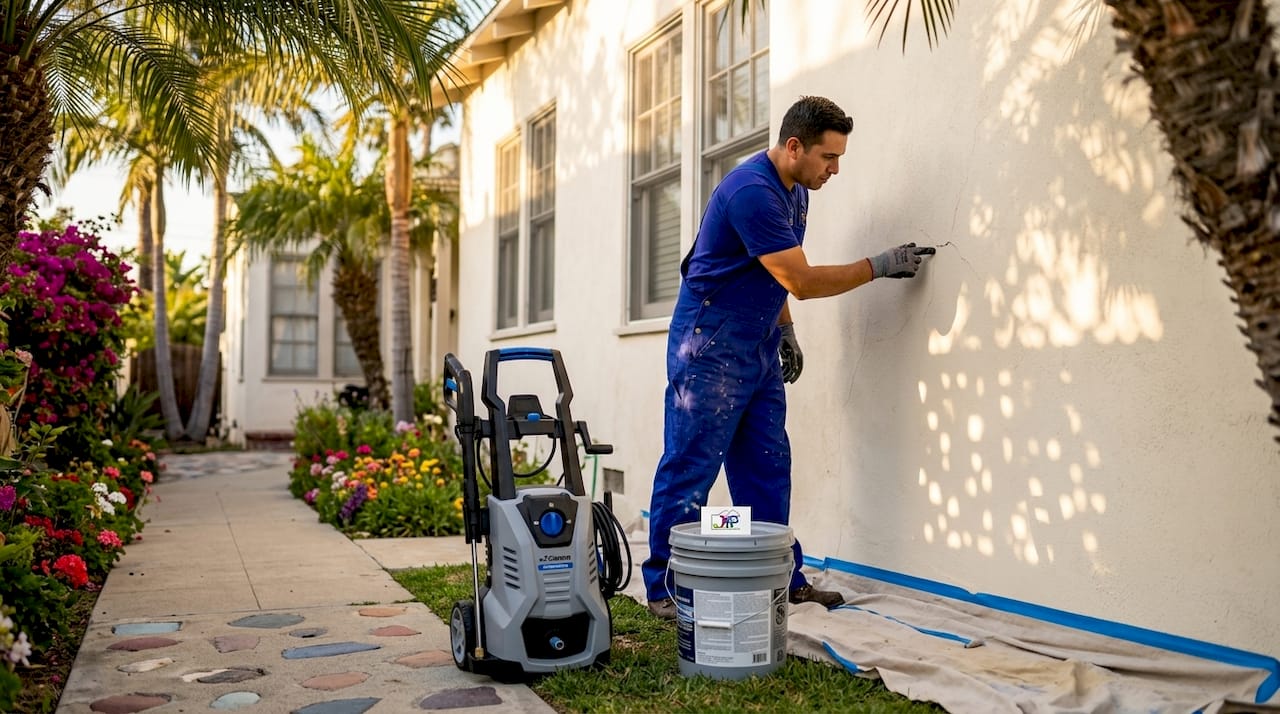
Pressure wash the surface to remove dirt, mildew, and biological growth. Use appropriate pressure settings for stucco to avoid surface damage.
Allow the surface to dry completely. Wait at least 24 hours after washing before applying any primer or paint.
Spot prime bare areas, repaired sections, and any locations where the old coating was removed.
Mask windows, doors, light fixtures, and any architectural details that should not be painted.
For new stucco specifically, the timeline extends considerably. Stucco needs to cure for at least 30 days before painting, then be pressure washed and dried before any coating goes on. Painting over green stucco traps moisture and causes blistering almost immediately. This is one of the most common mistakes on new construction HOA buildings.
For more guidance on prepping stucco exteriors in Southern California’s climate, including how heat and marine air affect curing times, those details matter significantly when planning your schedule.
Surface prep timelines by material
Surface type | Minimum cure/dry time before painting | Notes |
New stucco | 30 days | Moisture test recommended |
Pressure washed stucco | 24 hours | Longer in humid or overcast conditions |
Repaired stucco patches | 7 to 14 days | Depends on patch depth |
Painted wood trim | 4 to 6 hours after priming | Check manufacturer specs |
Previously painted concrete | 24 hours after cleaning | Test for adhesion first |
Signs that surfaces need attention before painting:
Bubbling or blistering on existing coatings
Dark spots or fuzzy growth indicating mildew
Paint that peels in sheets or flakes off easily
White powdery deposits (efflorescence) on stucco or masonry
Visible cracks wider than a hairline
“The coating system for stucco needs to be breathable and flexible. Trapping moisture behind an inflexible paint film on stucco is the single most common cause of premature paint failure on California multi-unit buildings.”
For professional painting prep best practices and a guide to safe pressure washing on HOA-grade exteriors, those resources provide additional depth on each step.
Select paints, coatings, and address stucco challenges
Choosing the right paint for an HOA building is not just about color. The coating system you select will determine how long the paint lasts, whether it traps moisture, and whether it can flex with the natural movement of stucco without cracking.
Properties to prioritize in coatings for HOA exteriors:
Breathability: Allows moisture vapor to escape through the stucco rather than building up pressure behind the paint film.
Flexibility (elastomeric coatings): Stretches with temperature changes and minor structural movement, reducing cracking.
Mold and mildew resistance: Critical in shaded areas of LA buildings that see limited direct sunlight.
UV resistance: Los Angeles sun is intense, and paints that lack UV stabilizers fade rapidly.
Low VOC (volatile organic compounds): Required by California air quality regulations and preferred by most HOA communities.
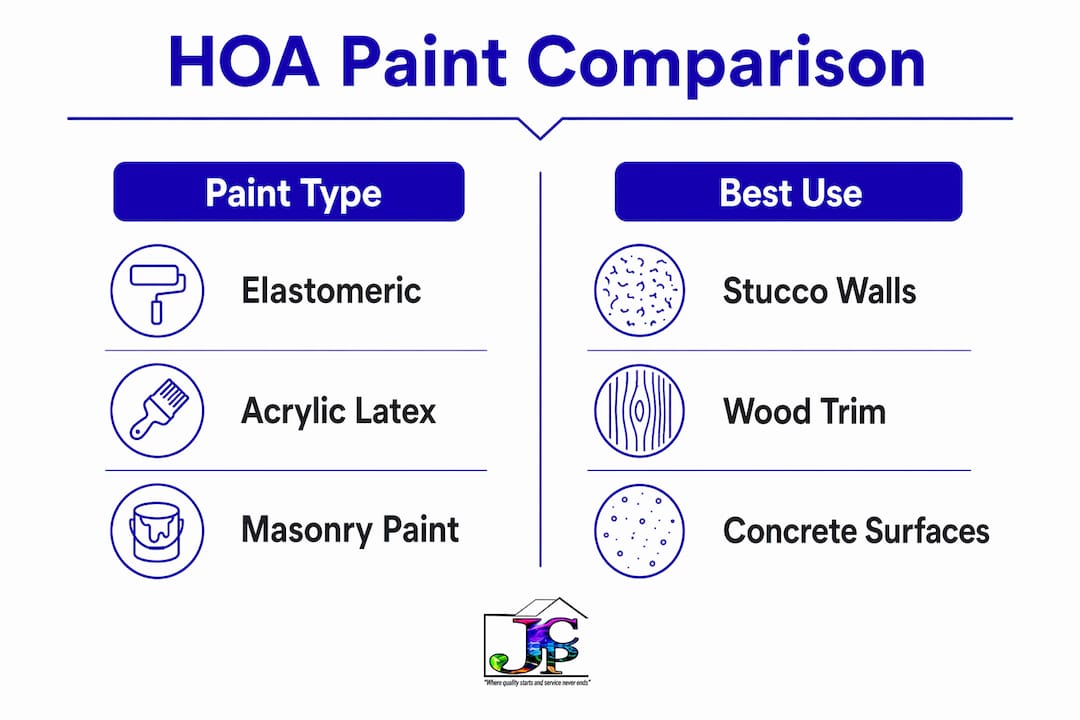
Comparing paint products for HOA exteriors
Paint type | Best use | HOA suitability | Longevity |
Elastomeric masonry coating | Stucco, concrete block | High | 10 to 15 years |
100% acrylic exterior paint | Wood trim, siding | High | 7 to 10 years |
Flat finish acrylic | Standard stucco exterior | High (common HOA spec) | 5 to 8 years |
Oil-based primer | Bare wood, metal | Medium | Primer only |
Epoxy coating | Parking areas, concrete | Situational | 5 to 10 years |
One of the most important decisions on a stucco building is how to handle cracks. Hairline cracks versus wider cracks affect your coating system choice significantly: very small cracks are often bridgeable with elastomeric paint, while larger cracks need repair and appropriate materials before repainting.
Pro Tip: Measure your cracks before ordering materials. Hairline cracks under 1/16 inch can typically be bridged with a high-quality elastomeric coating. Anything wider needs to be routed, cleaned, and filled with a compatible caulk or patching compound before primer or paint touches the surface.
For detailed guidance on larger structural issues, the stucco repair guide covers Southern California-specific repair approaches before painting begins. You can also explore exterior painting tips for additional product selection advice.
Color and finish compliance with your HOA palette should be confirmed before purchasing any materials. Order sample pots and test patches on a small section of wall to confirm the color matches under Los Angeles natural light, which shifts significantly from morning to afternoon.
Paint application and verification
With prep complete and materials selected, the application phase requires just as much care as everything that came before it. For multi-unit HOA buildings, the stakes are higher because a visible mistake on a shared exterior reflects on every unit owner.
Step-by-step application process:
Confirm that all masking is secure and covers windows, fixtures, and adjacent surfaces completely.
Apply primer to all bare spots, repaired sections, and any surface where the existing paint was removed or damaged.
Allow primer to dry per manufacturer specifications, typically 2 to 4 hours in Los Angeles summer conditions.
Apply the first coat of finish paint using a roller with the appropriate nap thickness for your texture (typically 3/4 inch to 1 1/4 inch for stucco).
Back-roll sprayed areas immediately to work the coating into the stucco texture and avoid lap marks.
Allow the first coat to cure fully, typically 24 hours, before applying the second coat.
Conduct a full visual inspection in different lighting conditions before declaring the project complete.
“On multi-unit exterior painting projects, physical safety is not optional. Proper scaffolding, harnesses rated for the height of the building, and secured work areas below are mandatory, not suggestions. California OSHA regulations apply to contractors and, in some cases, to property managers who direct the work.”
Using breathable coatings on stucco prevents the bubbling and cracking that comes from moisture and stucco movement, which is why the product selection in the previous step directly affects application outcomes.
Signs that your completed paint job meets HOA and durability standards:
Consistent color and sheen across the entire surface, with no streaks or lap marks
No bubbling, blistering, or wrinkling in the fresh film
Clean, straight lines at masking edges around windows and trim
All cracks sealed and filled flush before painting
Correct sheen level per HOA specifications (typically flat or low-sheen for stucco)
Pro Tip: Before the HOA conducts its post-paint inspection, walk the full perimeter of the building with your property manager or building supervisor. Catch and correct any issues while your crew is still on site. It is far cheaper to fix a lap mark the same day than to schedule a return visit after the inspection committee has documented it.
For ideas on maximizing curb appeal painting outcomes and understanding repainting benefits over the long term, those resources help you frame the investment for HOA stakeholders.
What most HOA painting guides miss
After 16 years of working on Los Angeles HOA buildings, the pattern is clear: the projects that go wrong almost never fail because of paint or technique. They fail because of communication gaps with the HOA board and management companies.
Most guides spend the majority of their content on product selection and prep steps. Those matter, but they are largely within your control once you understand them. What property managers consistently underestimate is how much the HOA communication process shapes the entire timeline and outcome. Getting approval for the wrong shade of taupe, missing a single document in your submission, or failing to notify residents of work dates can push a project back by weeks and generate noise complaints and board disputes that follow you long after the last coat dries.
The contrarian point worth making: even a like-for-like color repaint almost always requires formal submission. Many experienced property managers assume that matching the current color means skipping the queue. It almost never does. Most architectural guidelines treat any exterior painting as a change that requires review, regardless of whether the color is identical. Submitting anyway, even when you are confident it is a match, protects you from fines and dispute risk.
The stucco question is equally misunderstood. Contractors who primarily work on residential wood-frame homes sometimes apply the same system to stucco HOA buildings, using inflexible coatings that seal the surface without accounting for stucco’s need to breathe. The results show up 18 to 24 months later as blistering along the south-facing walls where heat and moisture cycling is most intense. Reviewing stucco painting methods specific to California’s climate before selecting products is the difference between a paint job that lasts a decade and one that fails in two years.
The toughest HOA projects are not about paint. They are about managing expectations, submitting complete paperwork on the first attempt, communicating clearly with every stakeholder, and choosing a contractor who has done this specific type of work before.
Professional help for HOA painting in Los Angeles
Managing every phase of an HOA painting project while also handling day-to-day building operations is a significant load. Experienced contractors who specialize in HOA exteriors understand the approval process, know how to document their work for architectural review boards, and carry the insurance and licensing that most HOA governing documents require.
At Johnny’s Custom Painting, we have spent over 16 years working on Los Angeles HOA and multi-unit residential buildings. Our work is documented in our exterior HOA painting portfolio, which showcases completed projects across a range of building types and community standards. For mixed-use and larger properties, our commercial painting services extend the same compliance-focused approach to commercial exteriors. As a licensed, insured Los Angeles painting contractor, we handle the documentation, prep, application, and post-paint walkthrough so you do not have to manage those details alone. Request a free estimate and let us help your HOA project go right the first time.
Frequently asked questions
Do I need HOA approval to repaint the exterior of my condo?
Yes, visible exterior painting requires HOA approval as stipulated in most governing documents. HOA governing documents outline the exact process for color and finish approvals, and California HOAs must issue written decisions within a defined timeframe.
How long should I wait before painting new stucco?
New stucco should cure for at least 30 days before painting, then be pressure washed and allowed to dry completely for a minimum of 24 hours before primer or finish coat is applied.
What paint type should I use for stucco to prevent cracks?
For hairline cracks under 1/16 inch, breathable elastomeric coatings are typically sufficient to bridge the gap. Larger cracks require repair with compatible patching materials before any coating system is applied.
What happens if I skip the HOA review process?
Painting without HOA approval can result in fines, mandatory repainting at your expense, or complications when selling or leasing units. Architectural review standards are enforced consistently across visible exterior changes, and violations are typically documented in HOA meeting records.
Recommended
Comments