
Paint fading explained: protect your Los Angeles home

TL;DR:
LA’s extreme sun, salt air, and pollution cause exterior paint to fade 30-40% faster than average.
Proper surface prep and high-quality UV-resistant paints significantly extend paint lifespan in LA.
Regular maintenance and strategic planning are essential to protect your home’s appearance and structural integrity.
If you own a home in Los Angeles, your exterior paint is working harder than almost anywhere else in the country. Sun, salt air, smog, and dramatic temperature swings create a relentless assault on your home’s finish. Paint in Los Angeles fades up to 40% faster than the national average, meaning the repaint cycle comes sooner and costs more than most homeowners expect. This guide breaks down exactly what causes paint fading, what realistic lifespans look like for LA homes, and the proven strategies you can use to keep your home looking sharp and well-protected for years.
Table of Contents
Key Takeaways
Point | Details |
LA paint fades faster | Paint on homes in Los Angeles can fade up to 40% quicker than the national average due to local climate and pollution. |
Surface prep is vital | Expert preparation can extend exterior paint life by up to 50% and slow down fading. |
Choose the right paint | Premium UV-resistant paints provide the best long-term color retention for LA homeowners. |
Regular maintenance pays off | Sticking to a repainting schedule keeps your property beautiful and protected from the elements. |
What is paint fading and why does it matter?
Paint fading is the gradual loss of color intensity and vibrancy from your home’s exterior surface. It’s different from other forms of paint failure, and that distinction matters when you’re planning maintenance or budgeting for a repaint.
Here’s how fading compares to other common paint problems:
Fading: Color washes out or dulls over time, usually driven by UV exposure and heat
Chalking: A powdery residue forms on the surface as the paint binder breaks down
Peeling: Paint lifts away from the surface, typically from moisture intrusion or poor adhesion
Cracking: The paint film splits or fractures, often from expansion and contraction cycles
Fading is sneaky because it happens slowly. You don’t notice it day to day, but one morning you look up and realize your once-vibrant exterior looks washed out and tired. By then, the UV damage driving the fade has likely already started weakening the paint film itself.
That matters because your exterior paint isn’t just decoration. It acts as a barrier between your home’s substrate (wood, stucco, concrete) and moisture, insects, and pollutants. When that barrier weakens, your home becomes vulnerable to rot, mold, and costly structural repairs. Fading is often the first visible signal that protection is breaking down.
“A home’s exterior paint is its first line of defense. When fading begins, the clock is already ticking on the underlying surface.”
Choosing the right types of exterior paint from the start plays a huge role in how quickly your finish fades and how well it shields your home in the process. Curb appeal and property value are also in the mix. Studies consistently link a well-maintained exterior to higher appraisal values, and faded paint is one of the first things buyers and appraisers notice.
Why does paint fade faster in Los Angeles?
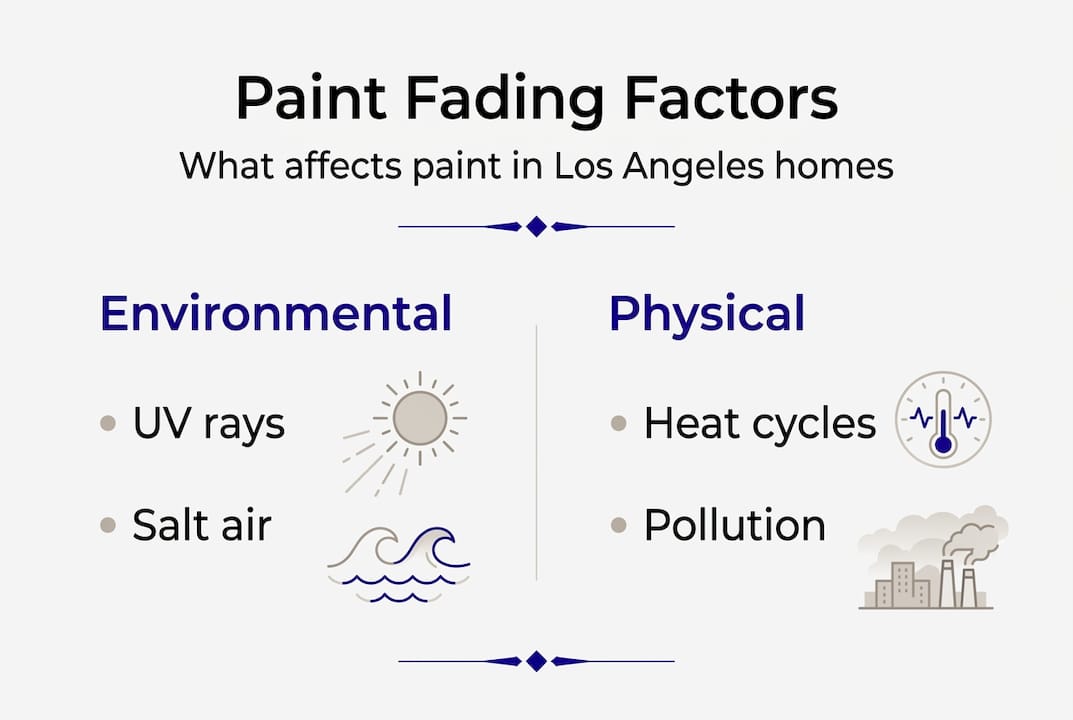
LA’s environment is genuinely tough on exterior coatings. Several forces work together to break down paint faster here than in most other American cities.
UV radiation is the biggest culprit. Los Angeles receives intense, near-year-round sun exposure. UV rays break apart the chemical bonds in paint pigments, which is what causes colors to dull and lose depth. Dark, saturated colors tend to fade the most visibly, though lighter shades are not immune.
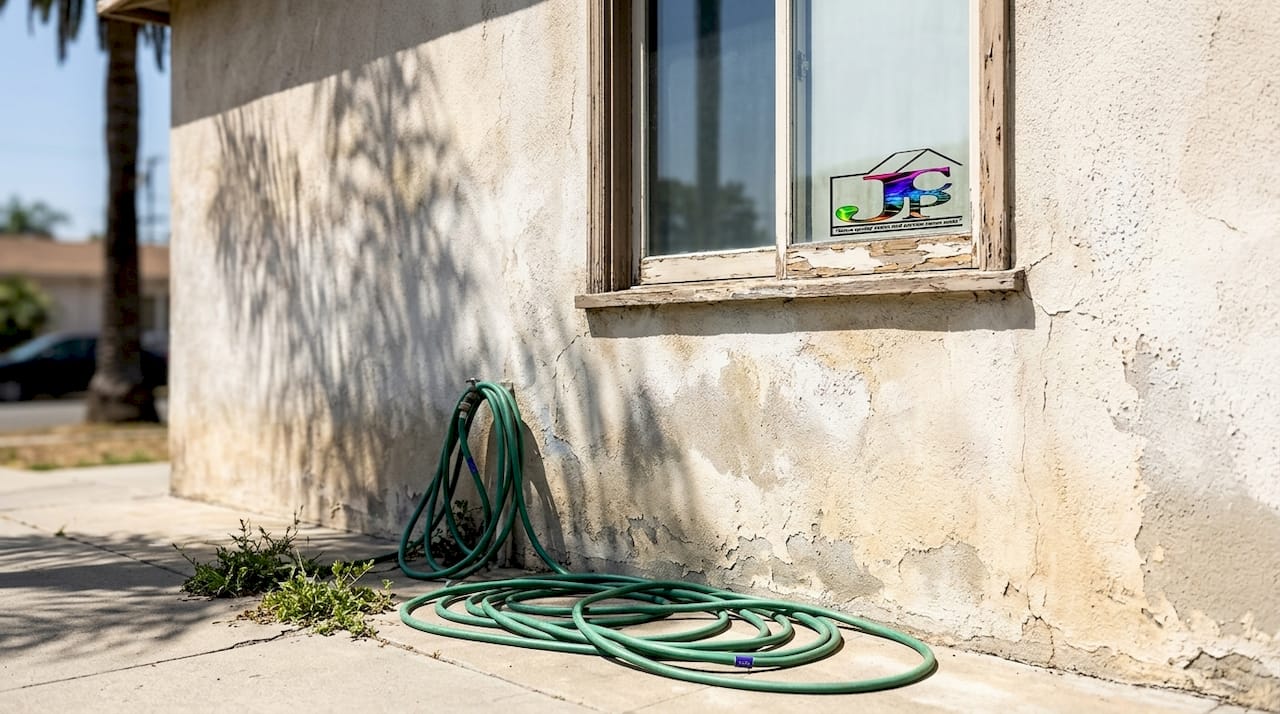
Heat cycles make things worse. When surfaces heat up and cool down repeatedly, the paint film expands and contracts. Over time, this micro-stress degrades the film’s integrity, making it less able to hold pigment and repel moisture.
Marine salt air is a serious factor for coastal LA neighborhoods from Malibu to Long Beach. Salt particles settle on painted surfaces and accelerate oxidation, eating away at the paint’s protective layers faster than UV alone would.
Smog and pollution add another layer of chemical stress. LA’s air quality, while improved, still carries pollutants that deposit on exterior surfaces and chemically degrade paint films over months and years.
Here’s a quick look at how these factors compare across LA locations:
Factor | Coastal LA (e.g., Santa Monica) | Inland LA (e.g., Pasadena) |
UV exposure | Very high | Very high |
Salt air impact | High | Low |
Smog/pollution | Moderate | Higher |
Paint lifespan | 5 to 8 years | 7 to 10 years |
The weather impact on paint in this region is well-documented, and understanding it helps you plan smarter. The combined effect of UV, salt, and pollution means that paint durability in LA is routinely 30 to 40% shorter than national benchmarks. That’s not a small difference. It translates directly into more frequent repaints and higher long-term maintenance costs if you don’t plan ahead.
How long should exterior paint last in Los Angeles?
Knowing the factors is useful, but what you really want to know is: how often will I actually need to repaint?
The answer depends on your home’s surface material, paint quality, and location within LA. Here’s a practical comparison:
Surface / Condition | Standard paint lifespan | Premium UV-resistant paint |
Stucco (inland LA) | 5 to 7 years | 8 to 12 years |
Stucco (coastal LA) | 4 to 6 years | 7 to 10 years |
Wood siding (inland) | 5 to 7 years | 8 to 12 years |
Wood siding (coastal) | 4 to 5 years | 6 to 9 years |
Masonry / concrete | 7 to 10 years | 10 to 15 years |
Premium UV-resistant paints can last up to 12 to 15 years with proper prep and application, while standard paints typically need replacement every 5 to 7 years in LA’s climate. That’s a significant gap, and the cost difference between standard and premium paint is almost always outweighed by the extra years you get before repainting.
If you’re dealing with painting stucco exteriors, which covers the majority of LA homes, the porous nature of stucco means moisture management matters just as much as UV protection. A paint that breathes and resists moisture while blocking UV will always outperform a basic coating.
Pro Tip: Check your home’s sun exposure by walking around at different times of day. South and west-facing walls take the hardest UV hit and will fade first. Plan your next repaint schedule around those walls, not the shaded sides.
If you want to get a realistic sense of what repainting will cost based on your home’s size and condition, reviewing painting cost estimates for the LA area can help you plan your budget well in advance.
How to prevent and reduce paint fading
Here’s the step-by-step approach that actually works for extending paint life on LA homes:
Start with thorough surface prep. Clean, repair, and prime every surface before applying new paint. Proper surface prep extends exterior paint life by 50%, which is far more impact than any single paint product can deliver on its own.
Choose UV-resistant, 100% acrylic paints. Acrylic formulas flex with temperature changes and resist UV breakdown far better than oil-based or low-quality latex paints. Look for products specifically labeled for high-UV environments.
Apply primer every time. Primer isn’t optional on LA exteriors. It builds adhesion, seals the substrate, and gives the topcoat something solid to hold onto.
Pay extra attention to vulnerable areas. Window trims, soffits, south-facing walls, and any spot near lawn sprinklers are high-risk zones for early fading and moisture damage.
Schedule annual wash-downs. Rinsing your exterior once a year removes salt, smog deposits, and dust that accelerate paint breakdown. A simple garden hose works for most surfaces.
Inspect and touch up as needed. Catching small chips or cracks early and touching them up prevents moisture from getting under the film and causing bigger failures.
Pro Tip: Avoid pressure washing painted stucco unless a professional is doing it. Too much pressure strips the surface and drives moisture into the wall, undermining the very protection you’re trying to maintain.
“The homes that hold their color longest in LA aren’t the ones with the most expensive paint. They’re the ones where the prep work was done right from the start.”
Investing time in exterior prep techniques before any paint goes on is the single highest-return activity in exterior maintenance. If the underlying surface isn’t properly cleaned, repaired, and primed, even the best UV-resistant paint will fade ahead of schedule. And if you want inspiration for what a well-executed exterior can look like, exploring curb appeal techniques gives you a practical visual framework for your own project.
The real reason paint fades so quickly in LA — and what most people miss
Most homeowners point at the climate when their paint fades early. And yes, LA’s sun and salt air are real forces. But after 16 years of painting homes across Los Angeles, we’ve seen the same pattern repeat: the homes that fade fastest aren’t the ones in the hardest climates. They’re the ones where corners were cut on prep or where the cheapest available paint was used to save a few hundred dollars.
The uncomfortable truth is that the LA climate simply exposes poor decisions faster. A bad paint job in a mild climate might look acceptable for a few years. Here, it starts showing failure within 18 months.
Generic advice like “use UV-resistant paint” is a start, but it misses the site-specific reality of your home. North-facing walls, shaded overhangs, and walls near irrigation systems all need different strategies. Blanket solutions rarely deliver the best outcome.
The paint durability best practices that genuinely work are rooted in understanding your specific home, not just following a general checklist. That’s what separates a paint job that lasts a decade from one that needs attention in five years.
Extend your home’s beauty and protect your investment
Knowing what causes fading is only part of the equation. The real payoff comes from working with professionals who understand LA’s unique conditions and can apply the right prep, products, and techniques for your specific home.
At Johnny’s Custom Painting, we’ve been protecting and transforming Los Angeles homes for over 16 years. Browse our exterior residential painting portfolio to see real results on LA homes just like yours, or explore our interior painting portfolio for full-home transformations. When you’re ready to take the next step, our team at Johnny’s Custom Painting is here to give you a free, no-pressure estimate and a plan tailored to your home’s exact needs.
Frequently asked questions
What causes exterior paint to fade in Los Angeles?
Intense UV radiation, coastal salt air, smog, and heat cycles all combine to accelerate paint fading in LA, reducing paint lifespan by up to 40% compared to national averages.
How often should I repaint my house in Los Angeles?
Most LA homes need repainting every 7 to 10 years inland, while coastal homes typically need attention every 5 to 8 years due to added salt air exposure.
What type of paint resists fading best?
Premium UV-resistant paints formulated for high-sun environments last the longest, potentially reaching 12 to 15 years when applied over properly prepped surfaces.
Is faded paint only a cosmetic issue?
No. Fading signals that the paint film is breaking down, which can leave your home’s substrate exposed to moisture and damage, affecting both appearance and structural protection.
Recommended
Comments